
Before the colonial record
Picturing the earliest human history of Melville Island takes imagination. What we know from before colonial record-keeping is extrapolation, and it is hard to picture the rolling forests of Nova Scotia before any permanent settlement. Some sources suggest the Northwest Arm was a hunting ground for the Mi’kmaq, but historians can only guess.
The first written impressions of the Northwest Arm come from French Acadian settlers, who from 1604 built small communities across what is now Nova Scotia and New Brunswick. By the late 17th century, local French settlers and Mi’kmaq gathered for the Feast of St. Aspinquid on the part of the Arm that is now Point Pleasant Park. When France and Britain signed the Treaty of Utrecht in 1713, handing Nova Scotia to the British, relations between the Mi’kmaq and colonial settlers grew strained. Despite a series of treaties through the 18th century, settlers continued to antagonize the Mi’kmaq.
Cowie’s Island and Kavanagh’s Island
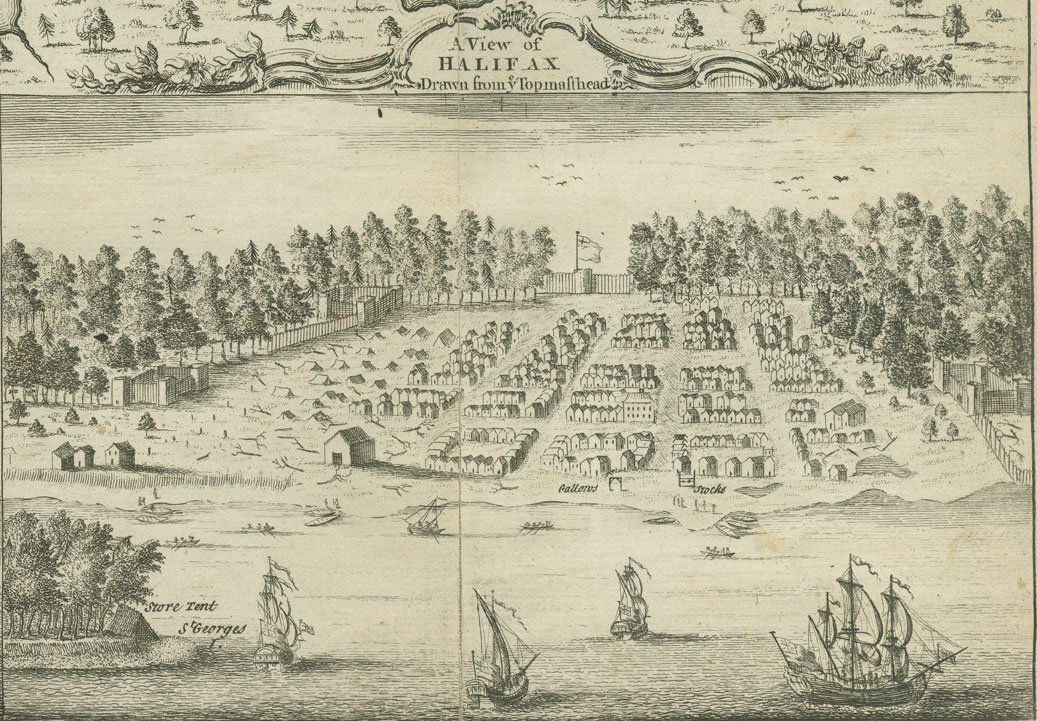
In 1749 the Crown sent Edward Cornwallis to establish a colony in Nova Scotia. With a fleet of transports he brought over a thousand sailors and their families to build what we know today as Halifax. From here, the picture of the early Northwest Arm becomes clearer. The earliest maps of the area around the new town show the Arm as far smaller than it really is, labelled the “Sandwich River.”
By 1752 the Northwest Arm had one of the two sawmills in the Town of Halifax. The Crown granted the 160-acre lot beside it to a baker, Robert Cowie, and a tavern keeper, John Aubony, who used Melville Island for a storehouse. The oldest sources that mention the island directly come from these two men. Soon after the grant, advertisements in the Halifax Gazette told “any persons that are inclin’d to make Shingles, Clapboards, Laths, Hoops” that the place was “very proper for that Purpose.” Soon after a “Black House compleatly finish’d, with a Stone Chimney and two Fireplaces” was built, Aubony died, and the land went largely unused for three decades.
In 1784 James Kavanagh, an Irish fisherman from Cape Breton who wanted to move his family to Halifax, bought the island to store and dry fish. His fishery ran out of what became Kavanagh’s Island until May 1793, when news reached Halifax that King Louis XVI of France had been beheaded.
The governor, John Wentworth, rented the island from Kavanagh as a possible place to hold French prisoners of war. Historian Brian Cuthbertson suggests Wentworth was also helping his friend Kavanagh, and giving his merchant friends contracts to feed and clothe the prisoners. But when Brigadier General James Ogilvie returned from St. Pierre and Miquelon with 600 French prisoners, he did not use the island, holding them instead in prison hulks and in barracks near Citadel Hill. Soon after, the French prisoners were removed from Halifax.
A prison hospital in the 1790s
Wentworth’s lease eventually paid off. A captured ship carrying wounded French soldiers from St. Domingo was brought into Halifax Harbour, and the public feared it carried a disease reported to be ravaging Pennsylvania. The outcry led Rear Admiral Murray to look for somewhere other than the Naval Hospital, where the prisoners were in the care of chief surgeon John Halliburton.
Kavanagh’s Island proved suitable, and records show 70 wounded French prisoners held there by 1795. The makeshift prison hospital must have been busy and short-staffed: Murray wrote that Halliburton had asked for an assistant surgeon because the hospital was in constant use. In 1796, 16 soldiers of the Royal Nova Scotia Regiment were stationed on the island, perhaps to guard the prisoners.
From these bare accounts it is hard to know exactly what the island looked like in the late 18th century. We can only imagine. Amid struggles between colonial powers over a continent they barely knew, Melville Island was a microcosm: stripped of its natural state, used for cottage industry, and taken over by larger forces. It became a focus for the fears of the era: of disease, of foreigners and of war.
Its time as a makeshift prison hospital was only a prelude. As the century turned and war loomed, Melville Island would become an essential piece of the province’s history.
Recommended reading
- Brian Cuthbertson, Melville Prison and Deadman’s Island: American and French Prisoners of War in Halifax
- Iris Shea and Heather Watts, Deadman’s: Melville Island and its Burial Ground
- Heather Watts and Michele Raymond, Halifax’s Northwest Arm: An Illustrated History
- Daniel N. Paul, We Were Not the Savages