
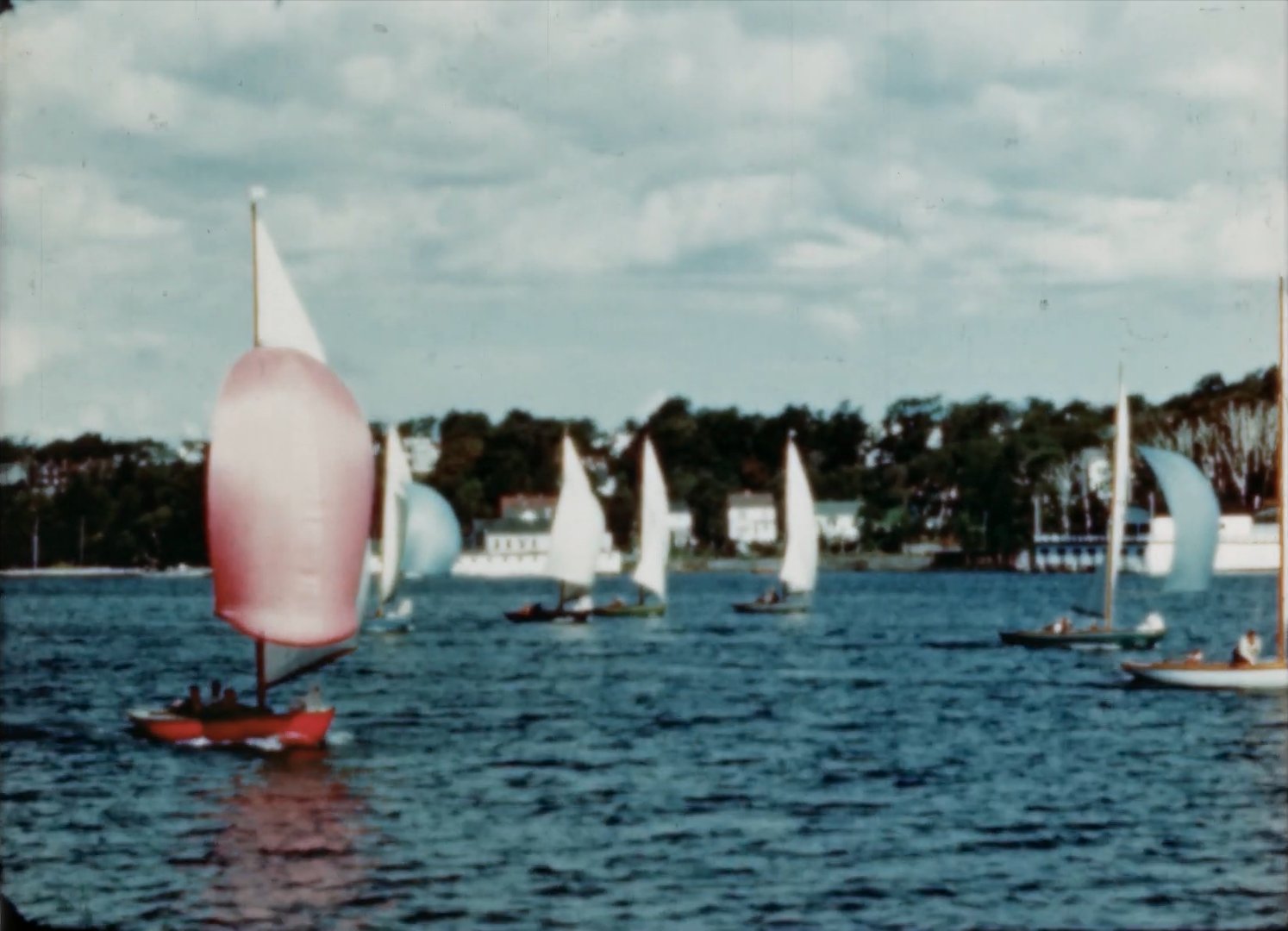
By the 1950s Melville Island had become a place for sailing and racing. After the move to the island the club grew to more than 300 members, including more than 50 junior members.
Generations of sailors
Much of the club’s energy came from its young sailors. Junior membership let a generation learn to sail on the island, and many of them still carry its traditions. Much of the credit goes to Frank Penny, a local insurance salesman who encouraged families to buy small boats called Morse dinghies for their sons.
The wooden boats were ideal for learning, with a skipper and one crew. When a skipper moved up to a bigger boat, he sold his Morse dinghy to his crewmate, so the small fleet passed from member to member. After a long day on the water, the island’s young sailors headed to the clubhouse kitchen for ice cream and sandwiches.
Built by volunteers
In the club’s early years on the island, building and repair fell to the members. Today the club employs three or four staff to look after the marina, but through the 1950s and 1960s volunteers did most of the work. Every year dozens of members whitewashed the walls and buildings. Members used the shell of the old prison chapel to build and repair boats until the building, worn out with age, was torn down in the late 1980s.
Almost everything was done by volunteers. Members built floating docks, fixed each other’s boats, sold each other paint and gathered in the wardroom, building a social life around the island.
Racing
Early on, the club decided to run both class races and handicap races. It chose the Snipe as its main racing class because, according to a newspaper clipping from the late 1940s, it was raced internationally, letting members “stack up against the best in the country, for international honours.” Over the years, as Melville Island became home to more large pleasure craft, class racing faded, and today the club runs mostly handicap races.
In the mid-1940s, at the urging of a group of club members, the naval architect W. J. Roué designed the Bluenose one-design class, named after his most famous design, the schooner Bluenose on the Canadian dime. Like the club’s other racing classes it faded over time, but it has made a comeback: the club runs Bluenose races every week during the season.
The sailing school
As the first generation of sailors grew up, junior membership lapsed. The club later converted an old prison storehouse into the first home of AYC Sailing School, which in 2001 underwent significant expansion that was funded almost entirely through the sale of anti-fouling paint to members. True to the Club’s 1937 statute, the Sailing School teaches sailing to people of all ages, and its Broader Reach program aims to make sailing accessible to communities that might not otherwise have the chance.
Melville Island today
Today the club is a gathering place, where members meet over a drink and watch friends race along the Arm. Members who keep larger boats at the marina head out to nearby coves for peace and quiet away from the city.
Melville Island stands as a testament to Halifax: a landmark that endured generations of war and disease and became a sailing club that dots the Northwest Arm with sails. Cared for by Armdale Yacht Club, it is a place for family and fun that looks after future generations while honouring the past.