
A prison for British soldiers
Between 1815 and 1855 Melville Island lay mostly empty, used now and then as a quarantine station.
Meanwhile the British army in Halifax had one place for its soldiers, their families and its prisoners: the fortress on Citadel Hill. Construction of the Citadel we know today began in 1828. Built to the latest standards for fear of American aggression, the star-shaped fort was designed to resist attack by land or sea. It was not finished until 1856, and by then it was crowded with the Halifax garrison and soldiers’ families.
There was little room for military prisoners, a problem made worse because the army was phasing out flogging as a punishment and replacing it with imprisonment.
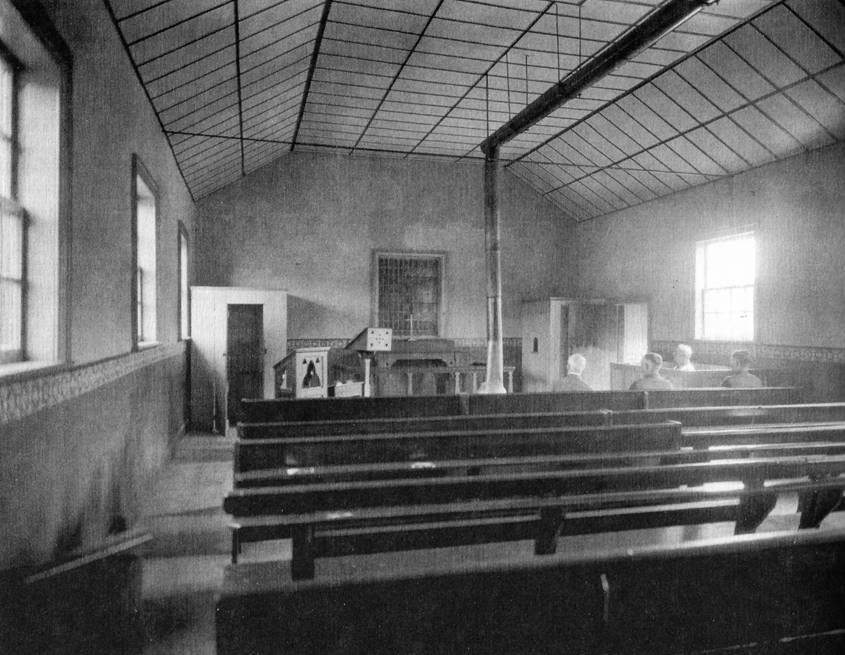
The army looked again to Melville Island. Having used it the year before as a depot for Foreign Legion recruits, the military bought the island in November 1856 for the large sum of £2,800. The long wooden building went back to its original use as a prison. This time, though, it held not foreigners but soldiers of the army that ran it.
Melville Island Military Prison as seen from Cove Road, Notman Studio collection, Nova Scotia Archives 1983-310 no. 9637
Melville Island became part of the Halifax military establishment again, and its upkeep was among the duties of the Citadel garrison: inspections every quarter, chimney sweeps every month and the sewers flushed twice a year. Each week an officer was named “weekly visitor” to make sure things ran smoothly.
Granite and shot drill
This was no open-air bazaar where prisoners could ply their trades. Before a single prisoner arrived, the chief warder, Jean Lepine, ordered 500 tons of granite from the Queen’s Quarry at Purcell’s Cove for prisoners to break as punishment. Prisoners wore grey jackets and trousers, striped shirts and forage caps.
Another punishment was “shot drill.” Prisoners carried 24-pound cannonballs, with perfect posture, from one side of the yard to the other, then back again. The drill was gruelling and pointless by design, meant to break their will.
Prisoners were not held for long, unlike the French and American prisoners of earlier wars, but escapes were still attempted. Accounts tell of prisoners using the stone hammers meant for breaking granite to threaten or attack the unarmed warders.
In the archives is assistant warder Thomas Noonan’s careful list of prisoners, recording each one’s name, regimental number and offence, and rating his attitude on arrival as “good,” “bad” or “fair.” Most were held for desertion, disorderly conduct or insubordination.
From British prison to Canadian detention barracks
In 1867 Nova Scotia, New Brunswick, Quebec and Ontario united to form the Dominion of Canada. Between 1870 and 1871 the British handed their military bases to Canadian authorities, except for two: Esquimalt in British Columbia, and Halifax. While the rest of the city adjusted to a new national identity, Melville Island and most other military sites in Halifax stayed firmly British for decades.
The island remained a British military prison until 1905, when the British withdrew their forces from Halifax and handed the dockyards and forts to Canada. Sometime between 1884 and 1905, the two-storey stone prison was built. Unlike the damp, cold wooden prison, it had light, ventilation and heating. Armdale Yacht Club still uses it for storage today.