
Halifax during the Napoleonic Wars
War on the world stage kept sending prisoners toward Halifax. French prisoners had been a headache for the Admiralty’s local representatives, who had tried and failed several times to remove them in the 1790s. Even so, Halifax was chosen as the site of a military prison.
At the start of the Napoleonic Wars, the British could not get a prison hulk large enough for their needs. They turned to the place where they had held French prisoners before: Kavanagh’s Island. Robert Murray, the Admiralty’s agent in Halifax, bought the island for £1,000, a large sum compared with the £64 John Kavanagh had paid for it 15 years earlier. It was renamed Melville Island, after the Admiralty’s new First Lord, Henry Dundas, Viscount Melville.
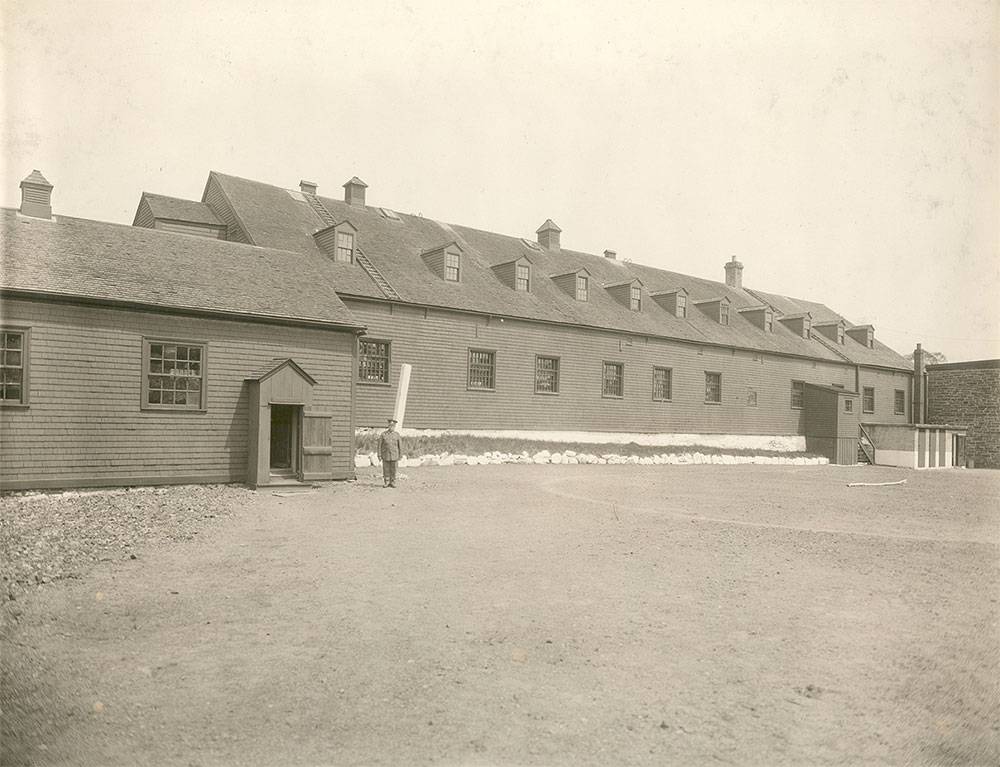
When it was bought, it was still a fisherman’s island, partly refitted to hold prisoners. A couple of storehouses had been turned into jailhouses, alongside a cookhouse and a barracks. At most it could hold about 200 prisoners.
In 1804 Captain John MacKellar replaced Murray and set to work. In 1805 orders went out for a long wooden prison building of about 200 feet (130 metres). MacKellar hired extra turnkeys and interpreters, and gave local merchants contracts to supply food and clothing. The new building had two storeys lined with iron posts, so hammocks could be slung one above another. This more than doubled the island’s capacity.
Melville Island as a military prison
From 1803, French prisoners were brought to the island from ships captured along the North American coast. British military records show about 1,500 French prisoners held at Melville Island between 1803 and 1813. Each was entered in the entry book with the details of his capture and issued yellow prison clothing, with “POW” in bright red on the jacket, shirt and trousers, along with a hammock and a blanket.
In 1805, letters from Governor Wentworth describe the murder of a Frenchman, Jean Marie Querrie, stabbed by a fellow inmate. His killer, Pierre Poulin, was tried in Halifax and executed on the Halifax Commons. Apart from this, most British records of the prison are orders and calls for tenders from merchants supplying food and clothing.
Life on the island
The 19th-century historian Thomas Beamish Akins wrote that the island was open to the public, and a favourite outing for young people on Sundays and holidays. Visitors talked with the prisoners and looked over the toys they made from wood and bone.
The fullest account comes from François Bourneuf, a Frenchman held on the island for three years before he escaped, settled in Nova Scotia and later sat in the Nova Scotia assembly. Many French prisoners were conscripted tradesmen, including jewellers and carpenters, and they were allowed to work. They fished, kept animals, sold eggs, ran card and dice games, and carved bone bought from Halifax butchers.
“The prison was like a small town fair.”
François Bourneuf, recalling his time on Melville Island
Escapes were a constant problem. Captain MacKellar offered rewards for recaptured prisoners and was reprimanded by the Transport Board for spending too much. About 130 prisoners escaped by 1813. Those who died were buried across the bridge, yet Bourneuf remembered the island as a healthy place. During these years Melville Island became part of the fabric of Halifax: a product of distant wars, woven into the life of the town.
Recommended reading
- Brian Cuthbertson, Melville Prison and Deadman’s Island: American and French Prisoners of War in Halifax
- Iris Shea and Heather Watts, Deadman’s: Melville Island and its Burial Ground
- Heather Watts and Michele Raymond, Halifax’s Northwest Arm: An Illustrated History
- J. Alphonse Deveau (ed.), Diary of a Frenchman: François Bourneuf’s Adventures from France to Acadia, 1787–1871
- Thomas H. Raddall, Halifax: Warden of the North
- Thomas Beamish Akins, History of Halifax City