
Nova Scotia and the War of 1812
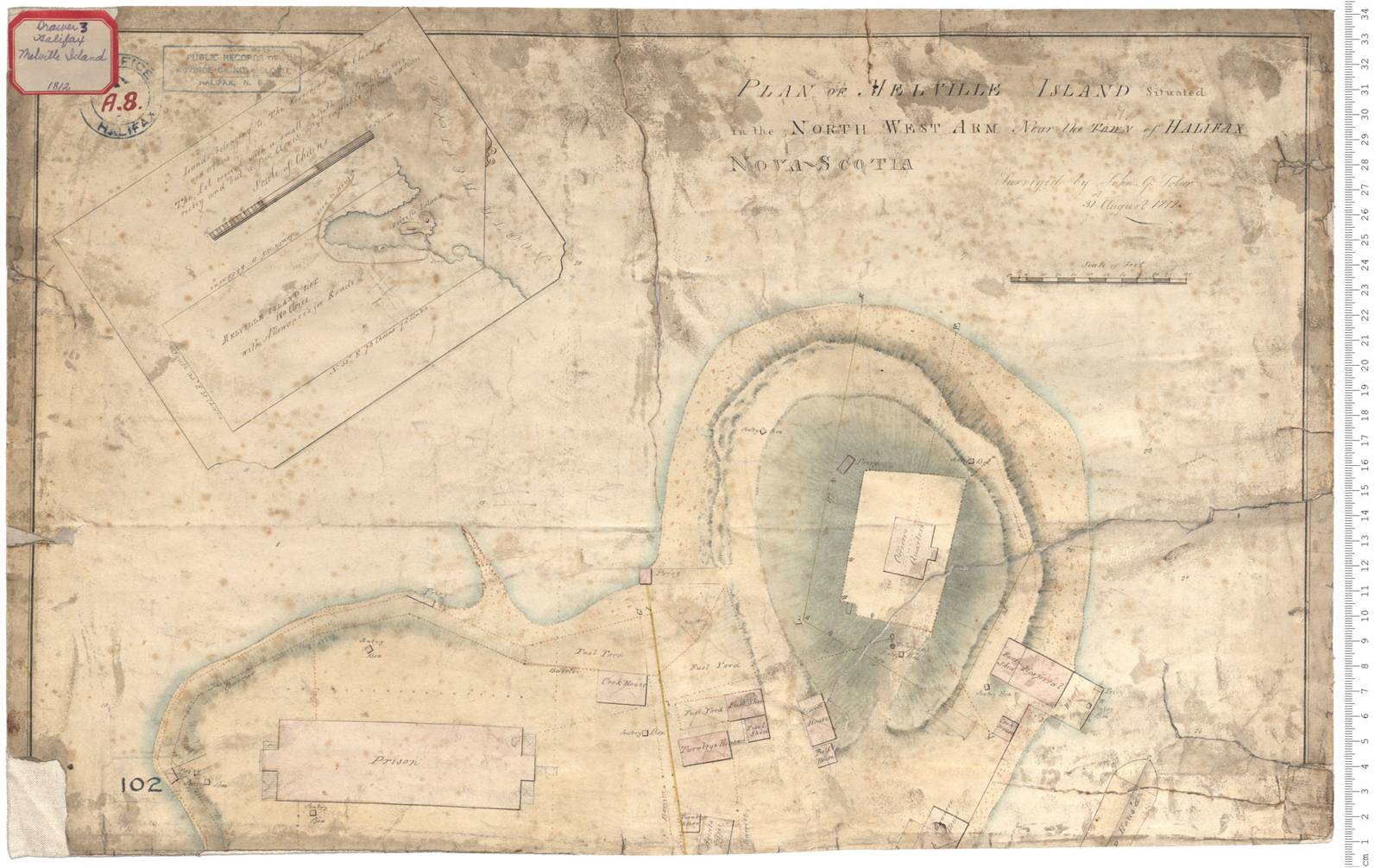
As soon as war broke out between the United States and Britain in 1812, conditions on Melville Island changed dramatically.
The defining feature of naval warfare in the War of 1812 was privateering. Private merchant and fishing crews could be issued “letters of marque” by their governments, allowing them to capture enemy ships, loot them and bring them back to home ports.
British restrictions on trade with France during the Napoleonic Wars had strengthened the “war hawk” faction in the American Congress, which pushed the United States to declare war. American sailors set out at once to capture British ships, bringing them and their crews into ports such as Salem, Massachusetts.
In response, the British issued letters of marque to ships along the Nova Scotian shore and the Bay of Fundy, where American privateers preyed on British shipping. Nova Scotian sailors took to the sea hoping to seize American cargoes. American seamen were well trained and had fast ships, but the tide began to turn in 1813, when the British gathered enough warships to blockade the American coast.
Source: Nova Scotia Archives Newspapers: Acadian Recorder 10 April 1813 page 3.
Americans at Melville Island
Over the next two years dozens of captured ships were brought into Halifax, with crews numbering from tens to hundreds. Only a few months into the war, about 2,000 American prisoners had been brought to Melville Island, and in each of the following two years at least 1,000 more were held at the prison.
One famous example was the capture of USS Chesapeake by HMS Shannon off Boston. The battle lasted only about 15 minutes but was bloody: the Chesapeake’s captain was killed and the Shannon lost around 30 men. When the Shannon brought her prize into Halifax Harbour, crowds gathered to watch, and for months local papers printed patriotic pieces celebrating the victory. The surviving Americans were taken to Melville Island.
Prisoners were still issued hammocks, blankets and meat, but the lively prison economy of the French years was gone. The Americans kept up their trades and gambling, but had much less freedom of movement. Once the American government appointed an agent to represent prisoners in Halifax, they could receive American goods, including tobacco. Many of the Americans held at Melville Island were not soldiers but privateers or merchant seamen treated as prisoners of war.
Life was harsh. Prisoners were woken each morning by the jailer and sent outside in all weather while the prison was cleaned. Benjamin Waterhouse, an American surgeon who wrote about his time on the island, described the jailer keeping prisoners out “for many hours, in the severest weather, when the mercury was ten and fifteen degrees below zero, under a pretext that the prison had been washed, and was not sufficiently dry for their reception: when in fact every drop of water used was in a moment ice.”
First-hand accounts
One of the most interesting accounts comes from James Fenimore Cooper, the American novelist best known for The Last of the Mohicans. Cooper wrote a biography of his friend Ned Myers, a Halifax-raised British subject who had joined the American side and was held on Melville Island. Told in Myers’s voice, it describes how he made money in the prison by counterfeiting Spanish dollars and passing them into Halifax, and how he escaped one rainy night.
Another first-hand account comes from Benjamin F. Palmer, an American private. His diary records daily life in the prison, the constant fear of being shipped to a prison in England, the rotten meat in the rations, and the affairs of his fellow prisoners. It includes a poem by an anonymous prisoner that sums up the hopelessness many felt:
A prisoner poor and out of sight.
Anonymous prisoner, in the diary of Benjamin F. Palmer (original spelling)
Confined from all enjoyment.
Doom’d through the day & endless night.
To live without employment.
On Melville Island doom’d to be.
By Centinals surrounded.
My home, my bed, a prison deck.
My heart with anguish wounded.
But soon I hope for sweet release.
In reahns of splended glory.
In scenes of love in bowers of peace
Where glows the blest Aurora.
After two years the war drew to a close. The Treaty of Ghent was signed on December 24, 1814, ending hostilities between Britain and the United States.
Deadman’s Island
During the two years of war, around 195 Americans died while held at Melville Island.
Next to the island was a small hill on a peninsula, used by the British for target practice and known as Target Hill. The dead were buried there in canvas bags, in unmarked graves. “4 prisoners [carried] to Target Hill this morning,” Benjamin Palmer wrote. “[The] place where they bury the Dead — I’m fearing full a number of us will visit that place this Summer, if not shortly releas’d.”
The only marked grave belongs to an otherwise unknown man named John Dixon, which has inspired many tragic tales. In one, a British officer disapproved of Dixon as a match for his daughter and had him sent to Melville Island, where he took his own life and was buried on Deadman’s. The story is romantic but unlikely: Dixon was most probably a man who died of fever aboard a Halifax merchant vessel.
Even so, the legend lives on. Palmer’s diary contains another poem by an unnamed American, capturing the sense of death that hung over the hill the prisoners looked out on every day:
Go view the graves which prisoners fill
Anonymous prisoner, in the diary of Benjamin F. Palmer (original spelling)
Go count them on the rising hill
No monumental marble shows
Whose silent dust does there repose —
Save that the papal cross is place’d.
Near to the graves where papest rest
All sleep unknown; their bodies rot
By all, save distant friends forgot.
After sickness, poverty, injury and insult, hunger, bitter winters and mild summers, the Americans on Melville Island heard that the war had ended only three months after it did. Ships came to Halifax Harbour to carry them slowly home to the New England towns they had sailed from.
Recommended reading
- Brian Cuthbertson, Melville Prison and Deadman’s Island: American and French Prisoners of War in Halifax
- Iris Shea and Heather Watts, Deadman’s: Melville Island and its Burial Ground
- Heather Watts and Michele Raymond, Halifax’s Northwest Arm: An Illustrated History
- Thomas H. Raddall, Halifax: Warden of the North
- Thomas Beamish Akins, History of Halifax City
- James Fenimore Cooper, Ned Myers, or, A Life Before the Mast
- The Diary of Benjamin F. Palmer, published by the Acorn Club
- Benjamin Waterhouse, A Journal of a Young Man of Massachusetts