
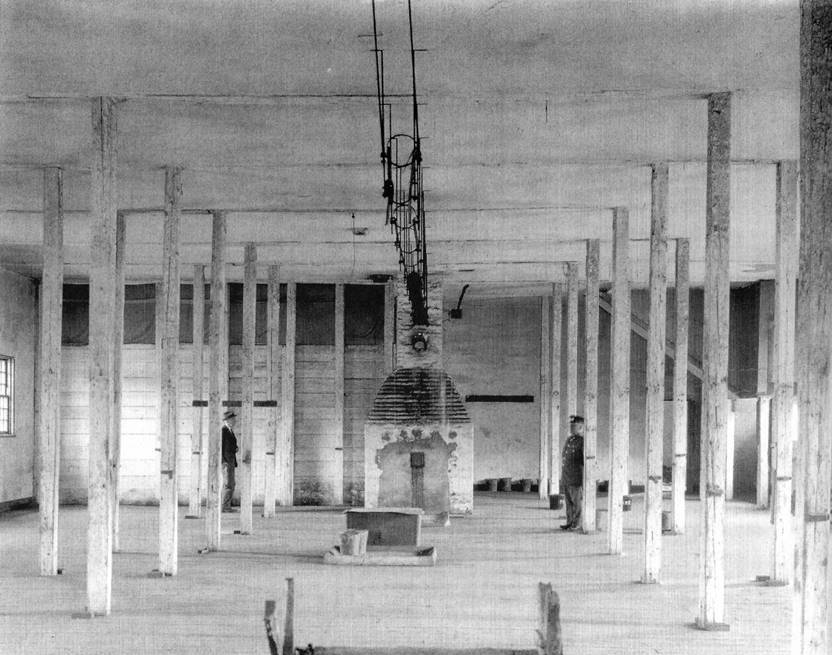
Detention barracks
In December 1905 the Canadian Permanent Force took charge of the prison on Melville Island. The Canadians rebranded it: in 1909 it became a “detention barracks,” and its inmates were no longer called prisoners but “soldiers in detention,” with no civilian criminal record.
The First World War
Everything changed when the First World War began. German men of military age were legally required to report for service, wherever they lived. Across North America, police were authorized to arrest and question German nationals. In Halifax, any German who co-operated and signed an undertaking not to enlist was released, but many said they wanted to return home.
German civilians and reservists in the area were held on Melville Island. In 1914 HMS Glory stopped the Spanish liner Montserrat, a neutral ship that had left New York carrying German reservists, and brought it into Halifax Harbour. The German men aboard were taken by boat to Melville Island and held as prisoners of war. Another 27 Germans were taken off a Dutch steamer and brought to the island, along with smaller groups and individuals arrested on the mainland.
The island had only a dozen or so Canadian soldiers, enough to look after a few unruly comrades but not more than a hundred Germans who spoke varying amounts of English. The commanding officer, Sergeant Major Cox, enlisted a militia of rural Nova Scotian men with little training. The guards struggled with the Germans’ names and gave them nicknames instead. Those on record include “the Sailor,” “the Millionaire’s Son,” “Yankee Jim” and “the Waiter.”
Some prisoners quickly took advantage of their inexperienced guards. The Germans spent their nights singing folk songs, and on one occasion used the singing to cover the sound of sawing through the floorboards. The Sailor, the Millionaire’s Son and the Waiter were among the first recorded escapees. The last recorded escape came on May 13, 1917, when three men cut through a door jamb during a storm.
The biggest problem was boredom. French and American prisoners had worked their trades, and soldiers in detention broke granite, but the Germans had nothing to do. One prisoner, Max Weinrauch, wrote to the authorities: “I beg you most courteously for some work for me, because I cannot endure to be for more time without anything to do.”
As the camp became overcrowded, many prisoners were moved, most often to Amherst, the largest internment camp in Canada, known for briefly holding Leon Trotsky in 1917. Records of the Melville Island camp are hard to find after the Halifax Explosion in December 1917, but the remaining prisoners were probably moved to Amherst. After the war the island went back to being a detention barracks.
The fire of 1935
The island’s history goes quiet again until 1935. The long wooden prison, built in the early 1800s, had stood all that time. On Wednesday, April 10, 1935, it was destroyed by fire. A neighbour, Roy Gilkie, took what became the last photographs of the building as it burned. After the fire only the stone prison remained in use, and when the Second World War began in 1939 the last soldiers in detention were moved to McNabs Island.